Joshua Trees
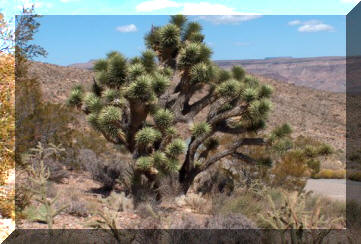
Yucca brevifolia:
Range: The deserts of extreme southwest California, Nevada, Utah and Arizona,are at elevations from 2,000 to 6,000 feet.
Habitat: Dry soils on plains, slopes and mesas, often growing in groves.
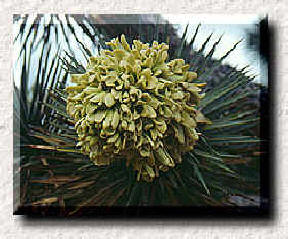
Flowers: Bell-shaped, 1.25 to 1.5 inches with 6 creamy, yellow-green sepals. Crowded into 12 to 18 inch, many-branched clusters with an unpleasant odor, mostly in the spring. Not all trees flower annually.
Fruit: Elliptical green-brown,
6-celled, 2.5 to 4 inches, somewhat fleshy. Dries and falls soon
after maturity in late spring revealing many flat seeds.
Description: The Joshua Tree, the largest of the yuccas, grows only in the deserts of the Southwest. Natural stands of this picturesque, spike-leaved evergreen grow nowhere else in the world. It's height varies from 15 to 40 feet with a diameter of 1 to 3 feet.
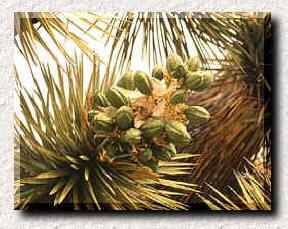
Joshua Tree Seed Pods
Photos by Dennis Ogden
Originally thought to be members of the Agave (Century Plant) Family, the Joshua Tree and other yuccas have been reclassified as members of the Lily (Liliaceae) Family. Two variations of the Joshua Tree are classified as J. brevifolia var. herbertii and J. brevifolia var. jaegeriana.
Joshua trees (and most other yuccas) rely on the female Pronuba Moth (Tegeticula) for pollination. No other animal visiting the blooms transfers the pollen from one flower to another. In fact, the female Yucca Moth has evolved special organs to collect and distribute the pollen onto the surface of the flower. She then lays her eggs in the flowers' ovaries, and when the larvae hatch, they feed on the yucca seeds.
Without the moth's pollination, the Joshua Tree could not reproduce, nor could the moth, whose larvae would have no seeds to eat. Although an old Joshua Trees can sprout new plants from its roots, only the seeds produced in pollinated flowers can scatter far enough to establish a new stand.
Mormon pioneers are said to have named this species "Joshua" Tree because it mimicked the Old Testament prophet Joshua waving them, with upraised arms, on toward the promised land.
More data on
Desert Life in the American Southwest, including: minerals and geology, animals
and wildlife, plants and wildflowers, people and cultures can be found at

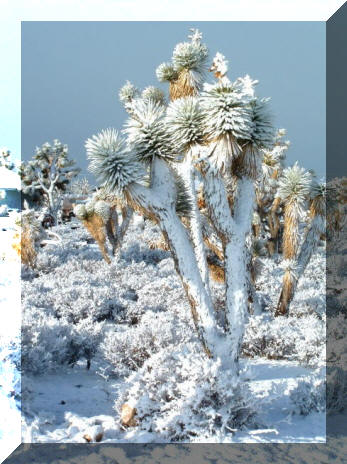
Just a "Cool Reminder" of Winter
(Photo By Annie)
Questions or comments about the website? E-Mail the webmaster.